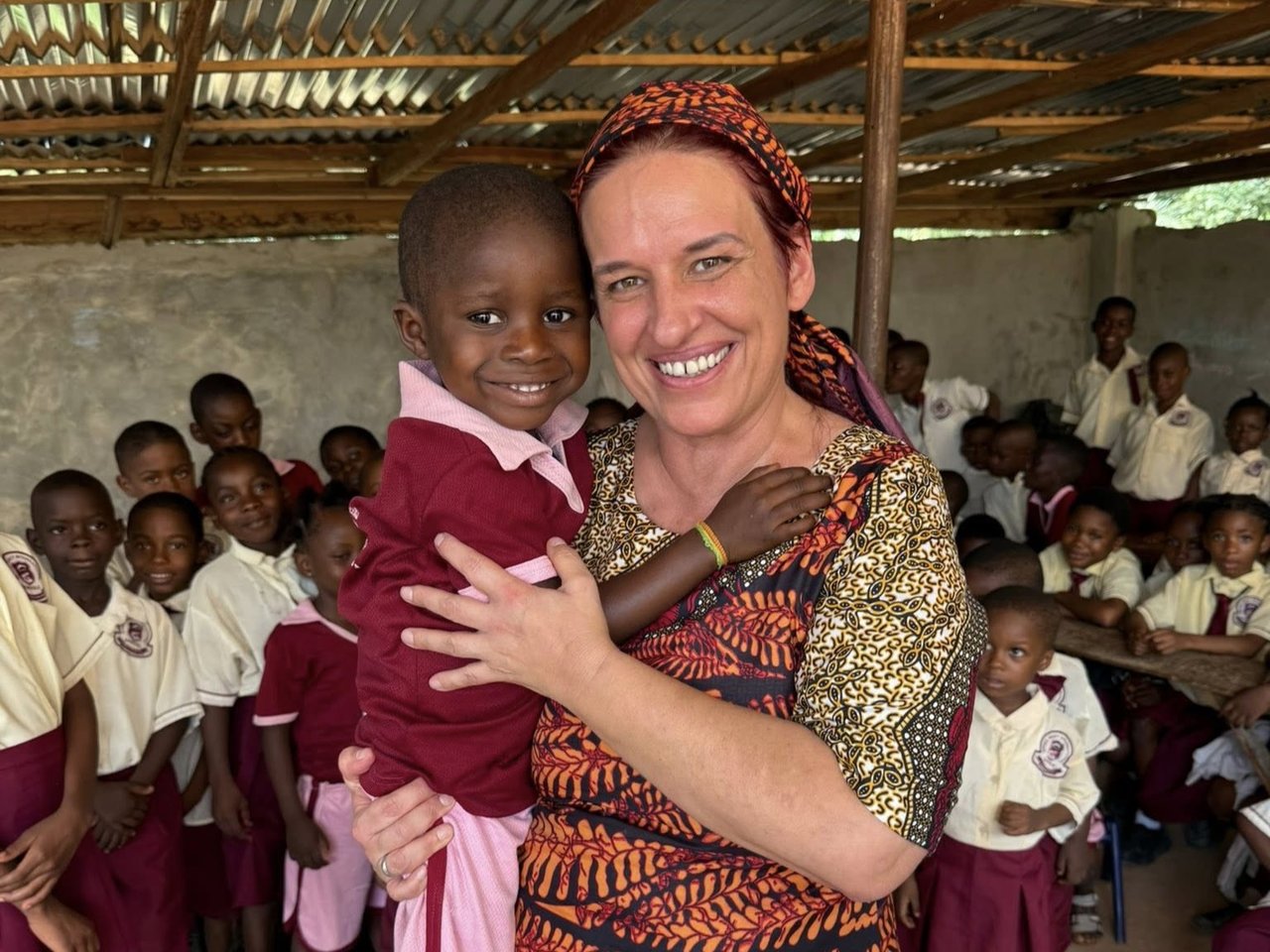
According to Réka Fodor, we can learn the most about living out faith and joy from Nigerians, as she is once again preparing to travel to the African country for her next—already twenty-third—medical mission. In Nigeria, despite poverty and hardships, she has seen far more happy and grateful people than at home. According to the head of the Afréka International Humanitarian Foundation, people there bring every joy and sorrow of their lives before God.
Source: Facebook / Afréka Foundation
Réka Fodor was born in Budapest in 1971. After finishing secondary school, she studied at the Faculty of General Medicine at Semmelweis University. She began her medical career in 1996 as a paramedic, and from 2002 she worked in the pharmaceutical industry. In 2002 she got married; her husband was the writer Sándor Greguss. Since 2005, she has been running her own general practitioner practice. She first visited Africa in 2015 as part of a medical mission in Uganda. Since 2016, she has been an accredited instructor at the Department of Family Medicine at Semmelweis University. She is the medical director of Ambulance Medical Ltd. and was a herald of the 52nd International Eucharistic Congress. Together with her husband, she founded the Afréka International Humanitarian Foundation.
“You have recently returned from Nigeria, but you will soon go back again. What exactly are you working on there now?”
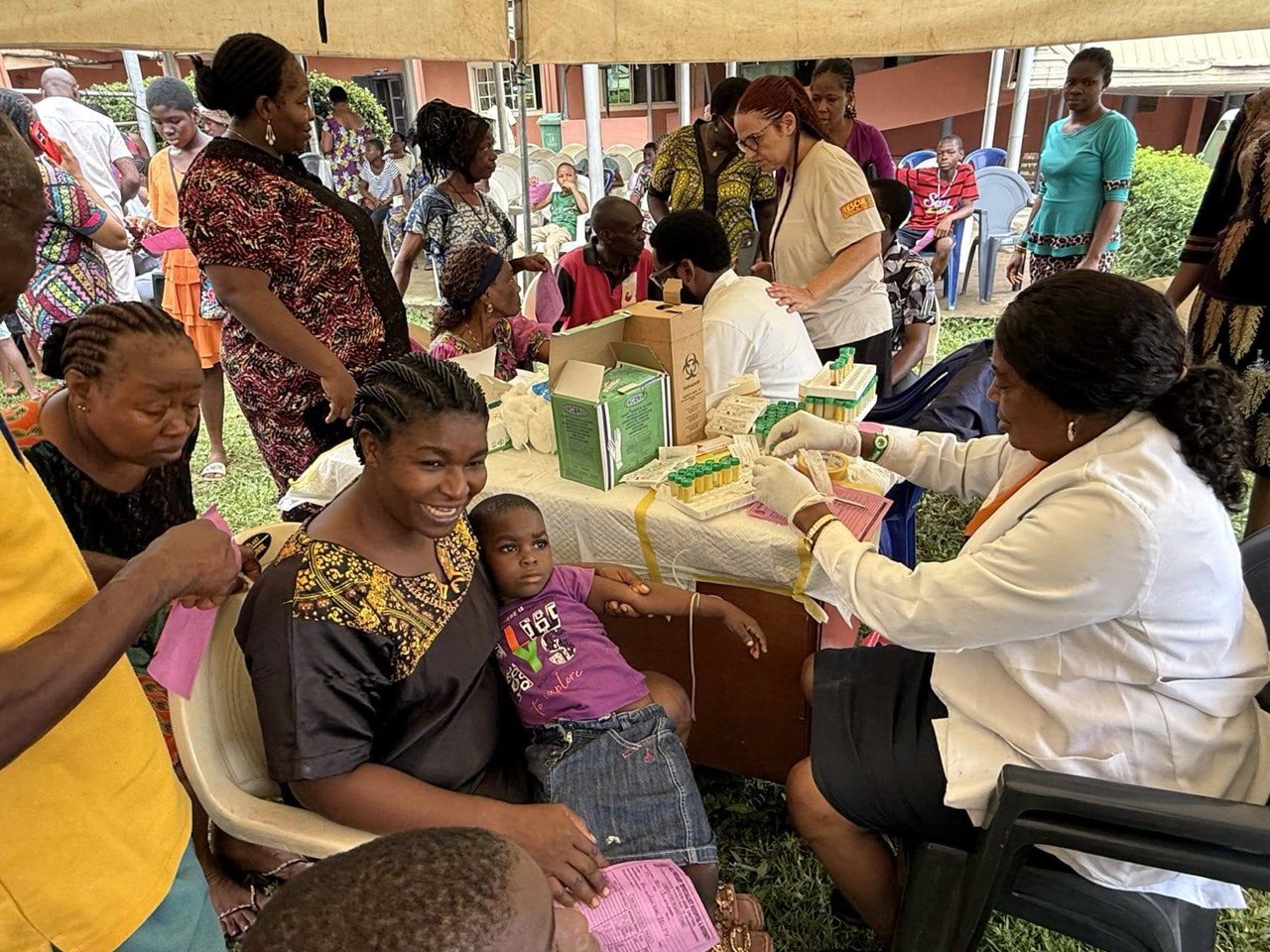
We are preparing the Afréka Foundation’s twenty-third medical mission, which will begin on March 26. I am taking a four-person team to Nigeria, but it’s not as simple as just going out and treating ten thousand patients—months of logistical preparation are required. Our previous mission was in November, and as soon as I returned, I immediately started raising approximately sixty thousand dollars for the spring mission, because that is how much one month costs.
We treat around two hundred patients a day. This costs at least ten dollars per patient, though in some cases much more. Even if we calculate with ten dollars, that means two thousand dollars per day, and sixty thousand dollars per month. In reality, it is even more, because we also need fuel, electricity, and we must provide for the team. The medicines are ordered months in advance by the local Catholic priests to ensure they arrive on time. They help enormously with the preparations; I speak with them several times a day by phone. They arrange for electricity, ensure that the tent is set up in the right place at the right time, and that staff are available every day. There is a four-hundred-capacity nursing school there, which we built with the help of the Hungary Helps program, and students from there often volunteer to help us—they are wonderful.
During the mission, we also sleep in the hospital, and every morning we head out into the field in a kind of radial pattern with a team of twenty to thirty people, because a patient with fever or malaria cannot walk seventy kilometers to reach a hospital. Organizing such a mission takes three months; as soon as we return from the March trip, I start organizing the summer one, then the autumn one—there is no stopping.
Malaria (historically known as “intermittent fever”) is a disease caused by parasites transmitted by female Anopheles mosquitoes. It is considered a widespread global disease, occurring in tropical regions. Each year, an estimated 350–500 million people become infected, and more than one million of them die from it.
Source: Facebook / Afréka Foundation
“How is the mission team assembled?”
The composition of the four-person team is always decided by God, not by me. I do not recruit people—they apply on their own. When a priest joins us, we place greater emphasis on evangelization, but this time three female doctors are coming with me: a neurologist and internist, a physiotherapist and movement therapist, and an ophthalmologist and eye surgeon.
We also organized a glasses donation campaign; I have already taken out two hundred kilograms of tested glasses. However, many people would need cataract surgery, so the ultimate goal is to establish an eye surgery unit, though this requires a great deal of funding. For now, we provide glasses to those who would benefit from them, while patients who require surgery are placed on a waiting list. When the funds for the ophthalmic operating theatre come together, we will be able to help them. This is currently my big dream. But this is how the neurosurgical operating room was also established—the funding for that also came together. If God continues to bless this foundation, as He has so far, then somehow this will also be achieved.
Source: Facebook / Afréka Foundation
“How do locals react when a team of white doctors appears in their village?”
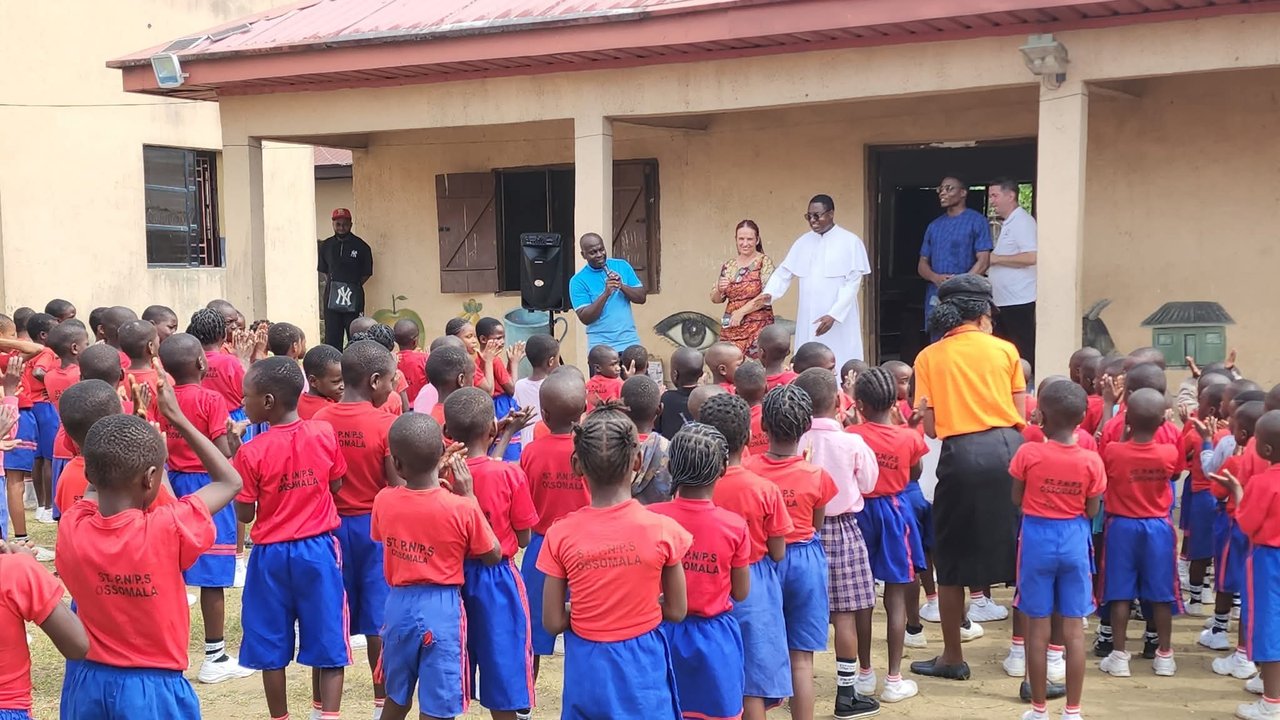
In the Nigerian city where we work, Onitsha, together with its surrounding area, around eight million people live there. Many have fled from the north to the south due to violence against Christians. So, the region has almost as many inhabitants as the whole of Hungary, yet almost everyone knows who “Doctor Réka” is, because we have been there so many times and helped so often.
When we began the missions ten years ago, the local Catholic archbishop invited us and introduced us, explaining to the locals that we had come from a European country that had no colonies. They did not believe that such a country existed. In Onitsha, I generally only meet white people when I bring them myself, so it is not a tourist destination. However, the locals are immeasurably grateful, and they find it difficult to understand that we help without any self-interest.
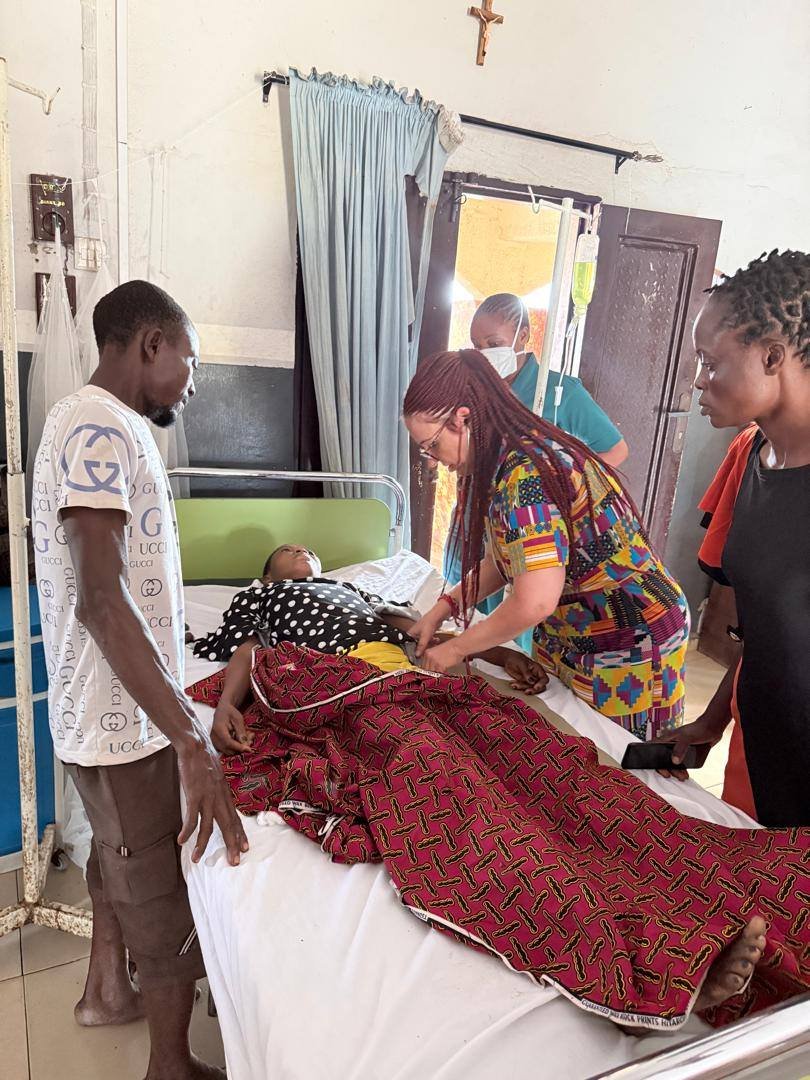
By now, we have proven ourselves; we have treated at least forty-four thousand patients through our missions. We have a good reputation. In addition to the eighteen trips to Nigeria so far, I have also been to several other African countries: twice to Ghana, and once each to Uganda, Chad, and Congo. I have experienced that people do not automatically admire someone just for being white, because they may assume that the intention is exploitation. That is why building trust is extremely important.
In places where our presence was not built up in this way, there were cases where people did not even thank us for the medicine, and I think many did not even take it. Not because they are worse people, but because they did not trust us. That is why I now always return to the same place, because there we have already gained their trust. We receive immeasurable love and gratitude, and when a person sees that they are helping and being useful, and that others improve as a result, it motivates them to help even more.
At times, there is almost too much gratitude and praise, and one must be very careful to attribute this glory to God, and not think that we have achieved it ourselves.
Source: Facebook / Afréka Foundation
“Did you find that people there experience faith and gratitude differently?”
Very differently. As a Catholic, I can mainly speak about the local Catholic Church. A Sunday Mass can have as many as ten thousand participants, and sometimes it is held in a field. There can be even a dozen Masses on a single Sunday: in school halls, in churches, in fields.
The Mass lasts three hours. At first, I could not imagine what one could do for that long, but the sermon alone lasts an hour. Once, a priest finished in twenty minutes, and people went up to him asking whether he was ill.
During the rest of the time, they sing and dance—not in a profane way, but as a form of praising God—and it is incredible how much they are spiritually filled during a Mass. In Hungary, people often cannot wait for the service to end, because lunch is burning or they have something important to do. In Nigeria, however, they devote the entire day to it, and after the Mass they stay, talk, eat together, and laugh together.
Of course, there are fewer entertainment opportunities; many people do not have internet or electricity, and there are hardly any cinemas. So, for them, Sunday is also a program that they eagerly look forward to. In the Catholic hospital, every morning begins with Mass at six in the chapel, and the entire staff is present. They live in faith.
Once I asked a Nigerian priest friend: how is it that you do not complain? There are no roads, no healthcare, no education, or only for a great deal of money. They live in a world without a social safety net; persecution of Christians is frequent; there is Boko Haram, the threat of terrorism, poverty, corruption, and many other difficulties. How is it that their faith is strong, that they are grateful, that they sing, and do not blaspheme God or complain?
And my priest friend answered:
“You have healthcare, education, and a social safety net, so when there is a problem, you expect the state to solve it. But since we have nothing, we can only trust in God.”

Source: Facebook / Afréka Foundation
Africa International Humanitarian Foundation
The foundation’s mission is to organize and support medical missions in underdeveloped countries, regions, and disaster-affected areas, as well as to promote public health education.
“Do they take everyday difficulties more lightly?”
Here, we take Xanax and other anti-anxiety medications, and we go to psychologists—which is, of course, not foolish—but I am simply saying that we have some kind of solution for everything. They only have their faith: they bring their problems before God.
Let me give an example: in an average family, six to eight children are born, as in our great-grandparents’ time, but at least one or two of them do not reach adulthood. I am also a mother—if one of my children died, I am not saying that I would not also need a psychologist or medication; I would feel that it was the end of the world.
Compared to this, they mourn the child, bury them, and move on. They do not go to psychologists, they do not take medication, because there is none. Yet somehow, they endure, and they are present at Mass. They also do not have such high expectations of life. In Nigeria, life expectancy is 52 years, and child mortality is high, mainly supposedly due to malaria, because they cannot afford the medicine.
I say “supposedly” because if someone has no money, the child may not even be born in a hospital, and they may not go there when they are sick—nothing can be known for certain. Everything is different there, yet when I return home, I see far more sad people in Hungary than in Nigeria. This is the hardest thing for me to understand.
I am not saying that everything is perfect here, but we live a thousand times better and more safely. For example, when I step out into the street, I do not think that I might be kidnapped. There are crimes here as well, but proportionally they cannot even be compared to those there. And yet I still see complaining, unhappy people here.
Meanwhile, I come from a country where, of course, there are very wealthy people, but for the majority it is also a challenge to eat three meals a day. It is Lent: last year I was there at this time, and I read out last year’s Catholic guidelines on fasting to one of the priests, and the locals looked at it as if it were the dream of millions of people—to eat the way that for us counts as fasting.
Most people do not starve to death, but as soon as a difficulty arises, for example a malaria or typhoid epidemic, there is no money to pay for medicine. If there is no mission team present at such times, many people die. Probably many have died since we have been talking.
But if I thought about this every minute, I would collapse, so one has to learn how to cope with it. I would rather say that I can hardly wait to go back and help as many people as possible.

Source: Facebook / Afréka Foundation
“What is the one thing we should learn most from Nigerians?”
To rejoice. I do not know how many Nigerian people you have met face to face, but there is that smile where all their teeth are visible. That is something we should definitely learn from them.
And their faith: when there is great trouble, they entrust that to God, and when something good happens, they bring that before Him as well and give thanks. Hungarians tend to forget God when everything is going well, because it feels natural. Usually, we start running to God only when there is great trouble: “Oh, help!”
They bring everything before God. And they do not express this gratitude only toward Him. A visitor is always seen as someone sent by God—even if they treat them badly, as colonizers once did. And if it is a missionary doctor, then even more so—they treat them as someone sent by God. When I go there to help them, they see it as a sign that God has not forgotten them.